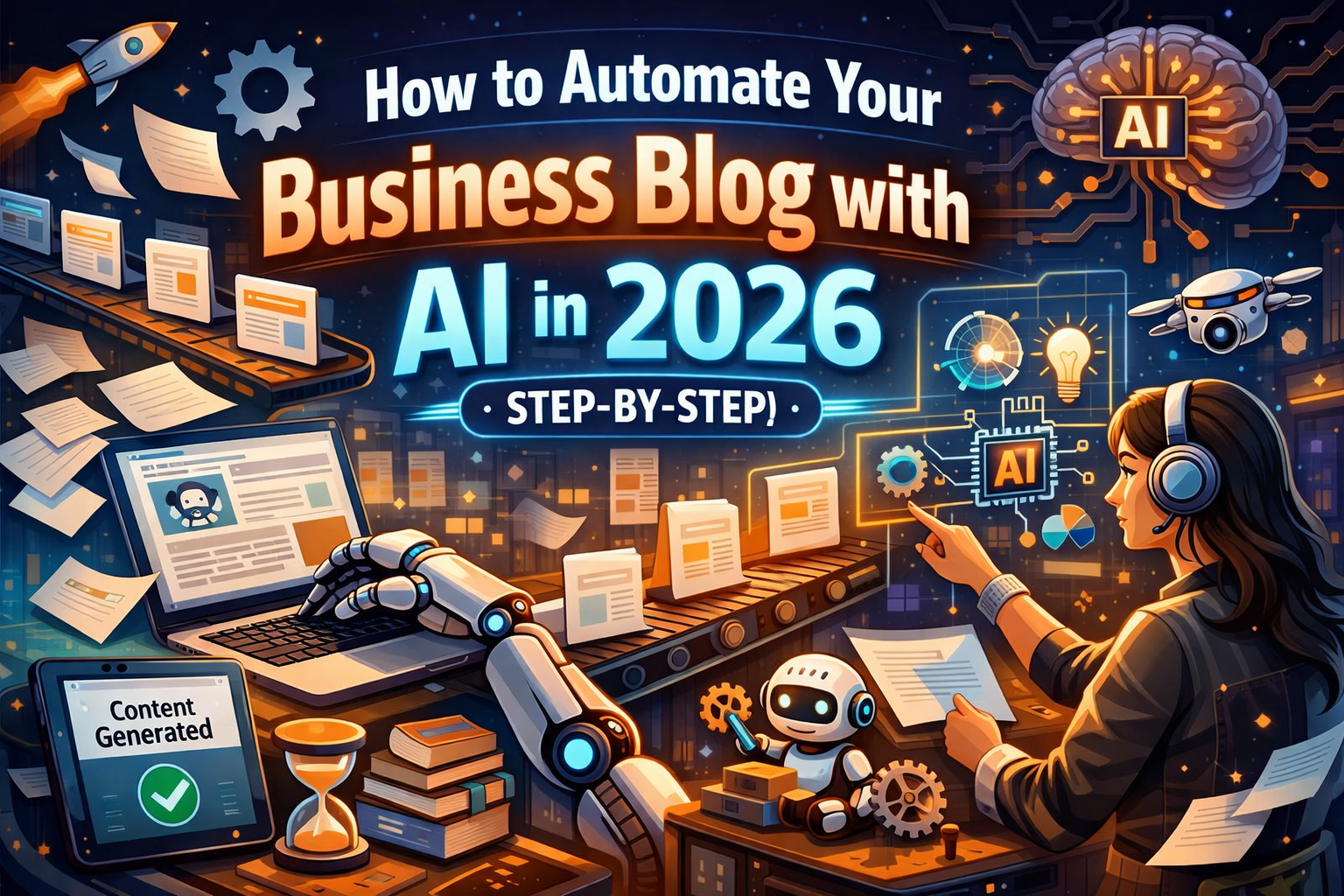
How to Automate Your Business Blog with AI in 2026 (Step-by-Step)
Overview and Definition of the Topic
In 2026, automating a business blog with artificial intelligence has become both a strategic necessity and a creative advantage for organizations. At its core, automation in blogging refers to the integration of AI-driven tools and workflows that can generate, optimize, publish, and distribute blog content with minimal human intervention. This technology enables companies to maintain consistent online engagement, develop thought leadership, and scale their content marketing operations efficiently. Artificial intelligence, natural language processing (NLP), and predictive analytics power these systems, allowing them to emulate human writing style, align with brand tone, and respond dynamically to audience needs.
The concept involves creating a sustainable ecosystem where data feeds, content scheduling systems, automated keyword analysis, and machine-assisted writing collaborate seamlessly. Unlike basic scheduling or template-based tools of the past, the AI blogging platforms of 2026 operate as adaptive systems that learn from user engagement metrics and automatically refine future outputs. Businesses use them not only for generating articles but also for curating content topics, managing search engine optimization (SEO), and personalizing posts for different audience segments.
Tracing Its Evolution Through Time
The path to full automation has been gradual. In the early 2010s, content marketers began using rudimentary tools such as post schedulers and keyword analyzers. The advent of deep learning between 2015 and 2020 accelerated progress, leading to sophisticated text-generation models that could draft coherent, context-aware posts. From 2020 to 2023, AI copywriting assistants became mainstream, capable of producing near-publication-quality text based on short inputs.
By 2024, integration between AI and customer relationship management (CRM) systems allowed businesses to generate content that reflected user data and purchasing behavior, bridging sales automation with content strategy. The introduction of multi-agent AI systems in 2025 enabled autonomous editing, citation verification, sentiment adjustment, and real-time feedback from analytics dashboards. In 2026, automation is no longer about delegating repetitive work; it represents a full-cycle ecosystem where ideation, writing, optimization, and performance tracking function in harmony.
Examining Key Concepts and Principles
Automating a business blog through AI rests on several core principles. **First**, there is the concept of data-driven creativity-the idea that algorithms can detect content opportunities by analyzing market trends, audience preferences, and competitor performance. **Second**, adaptive learning allows the system to evolve over time through user interactions and performance metrics. Each automated post informs the next generation of content strategies.
**Transparency** and **governance** also remain crucial.
As automated systems take on greater autonomy, businesses must ensure accountability in the content generated-verifying that the information produced meets ethical and brand standards. **Scalability** is another major principle: automation should handle increasing volumes of posts without compromising quality. Finally, **human-AI collaboration** is central to success. Automation does not eliminate human creativity; it redirects it toward strategic planning, content oversight, and brand storytelling refinement.
Role of Technology and Innovation
Technological innovation shapes every stage of blog automation. Modern AI systems rely heavily on advanced NLP models capable of understanding nuanced context, regional variations, and voice consistency across multiple languages. Deep reinforcement learning and federated learning allow the algorithms to improve privacy compliance and reduce bias by training on distributed data sources.
Cloud-based automation hubs provide centralized dashboards that orchestration managers and marketing professionals can control remotely. These platforms integrate with content management systems (CMS), SEO suites, and analytics tools to create an end-to-end automation stream. Real-time natural language generation (NLG) models evaluate audience sentiment through comment sections and adapt tone or vocabulary in future posts.
Emerging tools also introduce multimodal capabilities. For example, AI can now generate written blogs accompanied by automatically designed infographics, short video summaries, and voice narration. This convergence of design, text, and multimedia elevates marketing communication, making the automated blog not just a text portal but an immersive experience.
Industry Applications and Case Analysis
Businesses across industries use AI automation differently depending on goals, data accessibility, and customer profiles. In the **e-commerce sector**, automation creates personalized product features, seasonal campaign blogs, and comparison articles based on user purchase patterns. AI systems update the content daily, improving SEO visibility.
**Financial institutions** utilize AI automation to publish consistent reports on investment trends, foreign exchange updates, or compliance topics. Algorithms cross-check data from verified sources, reducing human error and ensuring timely insights.
In **healthcare and wellness industries**, AI automates educational content to clarify medical terminology for non-specialists. However, human review remains mandatory to prevent misinformation. **Technology companies** use automation to highlight innovations, product updates, and thought leadership ideas-building brand authority without straining content teams.
Case studies in 2025 showed that companies adopting AI-driven blog automation saw time reductions of up to 70% in content cycles and a 40% increase in lead conversion due to improved targeting accuracy.
Debates and Differing Viewpoints
Despite rapid adoption, the debate surrounding AI automation in business blogging remains complex. Advocates argue that automation democratizes content creation by allowing small businesses to compete with organizations possessing large marketing budgets. They emphasize that AI frees humans from repetitive work and enables more data-informed creativity.
Detractors, however, warn about authenticity erosion. Audiences may distrust AI-generated texts if they perceive them as generic or overly optimized. Critics also raise ethical concerns about transparency-should audiences be informed when reading an AI-generated blog? Additionally, the potential for misinformation or factual errors remains a persistent risk, especially when automated systems use unvetted sources.
Another contentious issue involves employment and creative identity. Some fear that content strategists, writers, and editors may be displaced, while others envision new hybrid roles such as “AI content architects” who supervise and fine-tune algorithms. Balancing efficiency and authenticity continues to define the debate in 2026.
Research Findings and Evidence
Recent research from digital marketing and information systems journals provides empirical evidence about automation’s influence on audience engagement and operational efficiency. Studies from 2024–2026 indicate that AI-assisted blogs achieve higher click-through rates and improved SEO ranking compared with entirely human-driven content. Machine learning optimization suggests that blogs updated more frequently-at least once every 48 hours—gain long-term advantages in visibility due to consistent indexing.
Behavioral studies show that readers value relevance and clarity above authorship, indicating that quality remains the primary factor for loyalty. Additionally, experiments conducted by several universities reveal that hybrid human-AI collaborations outperform both fully human and fully automated teams in delivering content that balances emotional resonance and factual precision.
However, research also highlights ongoing risks. Automated systems sometimes replicate biases in the datasets they’re trained on, leading to unintentional exclusionary language or one-sided analyses. Ethical AI frameworks have emerged to mitigate these risks by promoting explainability, fairness, and diverse training datasets.
Implications for Education and Policy
The rise of AI automation in content creation necessitates new educational priorities and policy frameworks. **In education**, universities and professional training programs must teach students not only writing and marketing strategies but also computational literacy. Understanding how AI composes, analyzes data, and optimizes workflow will become a core professional competency. Journalism and marketing programs now include modules on prompt engineering, AI ethics, and automated analytics interpretation.
**From a policy perspective**, governments and trade bodies face the challenge of regulating AI-generated content without stifling innovation. Regulations may require explicit disclosure when audiences interact with automated materials, and new copyright models must define ownership and responsibility for AI-created text. Industry standards could also set quality benchmarks for transparency, accuracy, and data protection in AI-driven communication.
The fusion of automation and communication policy will likely influence public trust. Ethical certification systems could emerge to validate AI content processes, assuring users that what they read meets accepted standards of fairness and truthfulness.
Emerging Opportunities and Risks
Automating business blogs with AI opens a vast array of opportunities. Companies can expand global reach by generating multilingual content automatically. Predictive systems can anticipate seasonal topics before trends peak, positioning brands as early thought leaders. Personalized recommendation engines can modify blog format or tone according to reader segments, increasing engagement and retention.
Yet with exponential possibility comes corresponding risk. Overreliance on automation can lead to homogenization of content, blurring brand differentiation. Security vulnerabilities may arise if automation pipelines connect to external databases without adequate safeguards. Intellectual property questions continue as AI-generated text challenges traditional authorship models.
The environmental cost of large-scale AI computation also surfaces as an industry concern. As complex training models increase energy usage, organizations must balance achievements in efficiency with sustainability commitments. Building leaner, resource-efficient AI systems represents both a moral and logistical imperative in the coming years.
Concluding Reflections and Future Outlook
The automation of business blogging has moved beyond novelty to become a defining element of modern content ecosystems. In 2026, businesses that strategically deploy AI enjoy faster publication cycles, better decision-making, and wider audience reach. However, the challenge lies not simply in implementing technology but in governing it responsibly—preserving creativity, credibility, and trust.
Future developments suggest deeper integration between AI blogging platforms and immersive technologies such as virtual reality meeting spaces or voice-driven artificial assistants. Readers may soon experience interactive blogs that respond conversationally, offering targeted insights or related media on demand. The boundary between reader and participant could dissolve, transforming the traditional notion of a blog into an adaptive, intelligent dialogue system.
Ultimately, automating a business blog with AI requires thoughtful orchestration between human strategic oversight and machine precision. The strongest organizations in 2026 and beyond will not be those that automate the most, but those that automate wisely—aligning technology, ethics, and creativity to serve both business objectives and the evolving expectations of digital audiences.